









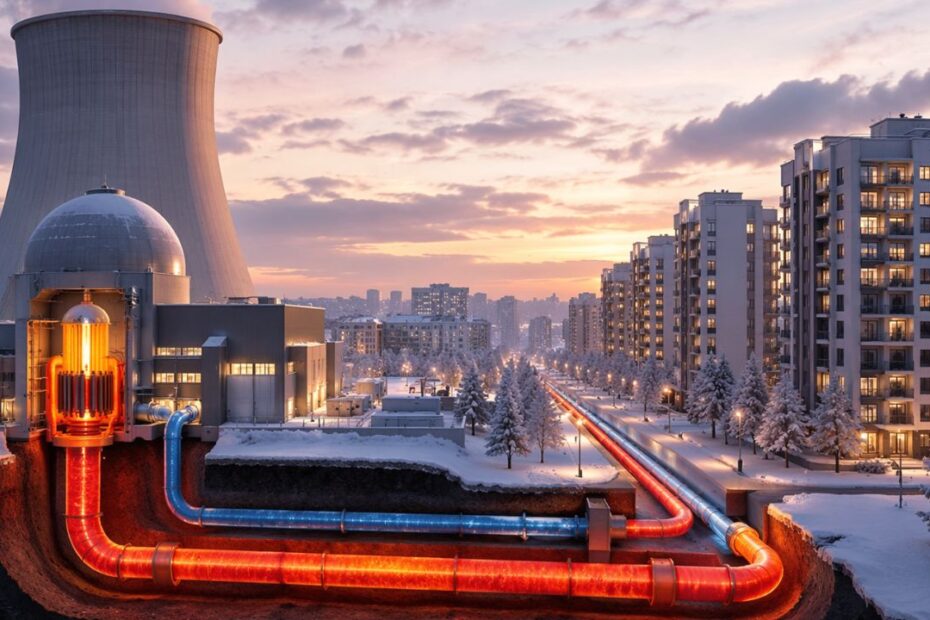
Around the world, nuclear energy is no longer limited to electricity generation. Many countries now use nuclear heat to warm homes, offices, and entire cities through efficient systems.
This method, known as district heating, is gaining attention because it is clean, reliable, and reduces dependence on fossil fuels. However, despite having nuclear power plants, India has not widely adopted this technology.
What Is Nuclear Heating?
Nuclear heating uses heat produced inside nuclear reactors and sends it directly to buildings through insulated pipelines. Instead of wasting excess heat during electricity production, this system captures and uses it efficiently. In some cases, up to 90% of the heat energy can be utilized, making it highly efficient compared to traditional systems.
Countries Using Nuclear Heat
| Country | Location/Project | Key Details |
|---|---|---|
| China | Haiyang | Heats more than 200,000 homes |
| Russia | Pevek, Bilibino | Provides both heat and electricity |
| Switzerland | Beznau | Supplies heat to nearby towns |
| Finland | Helsinki (planned) | Testing small modular reactors |
| Sweden | Earlier projects | Used nuclear heat in district systems |
Important Facts and Figures
- China’s Haiyang project cuts about 180,000 tons of carbon emissions every year
- Nuclear heating can replace millions of tons of coal annually
- Small Modular Reactors (SMRs) are being developed for local heating needs
- Nuclear systems provide continuous heat supply, unlike solar or wind
Why India Has Not Adopted It
Climate Conditions
India has a mostly warm climate, so large-scale heating demand is low compared to colder countries.
Infrastructure Cost
Building district heating systems requires extensive pipeline networks, which are expensive and difficult in crowded cities.
Policy Focus
India’s nuclear sector mainly focuses on power generation, not heat distribution.
Public Concerns
Safety concerns and lack of awareness about modern nuclear technology slow down adoption.
Benefits of Nuclear Heating
- Very low carbon emissions
- Reliable and stable energy supply
- Reduces dependence on coal and gas
- Efficient use of energy that is otherwise wasted
Nuclear heating is a smart and proven solution already working in several countries. While India may not need it everywhere due to its climate, it could still be useful in colder regions or for industries.
With rising energy demand and environmental challenges, exploring this technology can help India move toward a cleaner and more efficient future.
FAQs
What is nuclear heating?
It is the use of heat from nuclear reactors to warm buildings through pipelines instead of only producing electricity.
Is nuclear heating efficient?
Yes, it can use up to 90% of generated heat, making it highly efficient.
Can India adopt nuclear heating?
Yes, but mainly in specific regions or industries, with proper infrastructure and planning.