









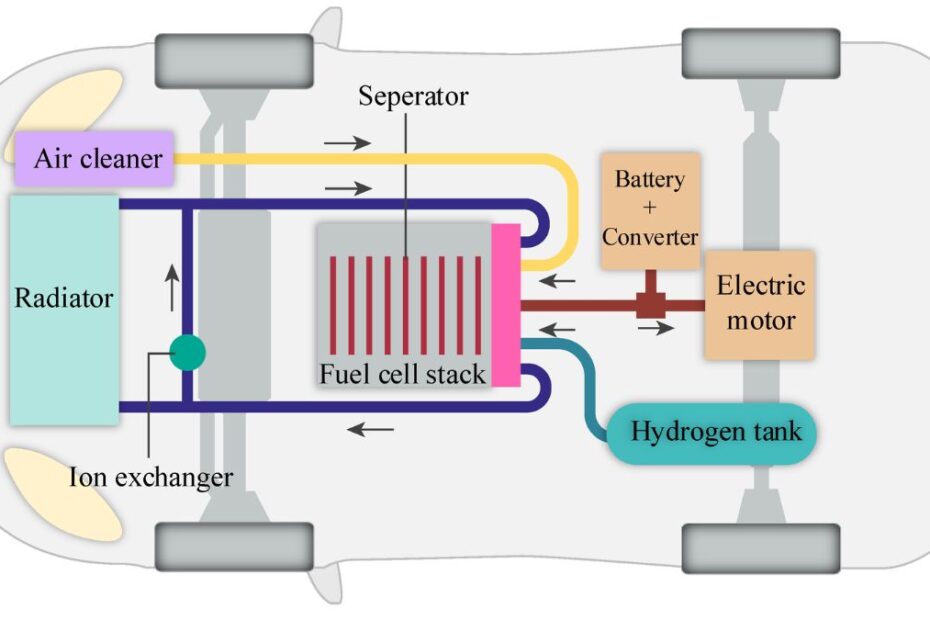
The new design by Australian academics allows water that is usually trapped to escape, thus significantly improving performance
Clean energy is becoming more important every day, and scientists are working hard to find better ways to produce power without harming the environment. Now, researchers at University of New South Wales in Sydney have made an exciting breakthrough.
They have created a new fuel cell technology that can produce 50% more power using the same amount of hydrogen. This means better efficiency, lower costs, and a big step forward for hydrogen energy solutions.
What Is This New Fuel Cell Technology?
The new invention is a type of PEM (Proton Exchange Membrane) fuel cell, which is already widely used in clean energy systems. These fuel cells convert hydrogen into electricity, producing only water as a byproduct.
What makes this new design different?
The main improvement is very simple but powerful:
- It allows trapped water to escape more easily
- This prevents blockage inside the fuel cell
- It improves the overall performance and efficiency
In older fuel cells, water often gets stuck inside, which slows down the reaction and reduces power output. By fixing this issue, the new design makes the system much more effective.
How Does a PEM Fuel Cell Work?
To understand the improvement, let’s look at how a basic fuel cell works:
- Hydrogen enters the fuel cell
- It reacts inside the membrane
- Electricity is generated
- Water is produced as a byproduct
The problem? That water can sometimes build up and block the system.
The new design ensures better water flow, keeping everything running smoothly.
Key Benefits of the New Fuel Cell
Here is a simple table to understand the advantages:
| Feature | Old Technology | New UNSW Fuel Cell |
|---|---|---|
| Power Output | Standard | 50% higher |
| Water Management | Poor (water gets trapped) | Improved flow |
| Efficiency | Moderate | High efficiency |
| Cost | Expensive materials | Low-cost design |
| Performance Stability | Can drop over time | More stable |
Why This Breakthrough Matters
This new technology is not just a small upgrade—it can change the future of clean energy.
1. More Power with Less Fuel
Getting 50% more power from the same hydrogen means we can save resources and reduce costs.
2. Better for the Environment
Hydrogen fuel cells produce only water, making them one of the cleanest energy sources available.
3. Lower Costs for Energy Systems
Because the design is low-cost, it could make hydrogen energy more affordable for industries and households.
Real-Life Applications
This new fuel cell technology can be used in many areas:
Electric Vehicles
Hydrogen-powered cars could travel longer distances with the same fuel.
Renewable Energy Storage
It can store and supply energy more efficiently for solar and wind systems.
Industrial Use
Factories can use this technology for cleaner and more efficient power generation.
The Future of Hydrogen Energy
The work done by University of New South Wales shows that even small design changes can create big results.
As countries look for ways to reduce pollution and move away from fossil fuels, technologies like this will play a key role. Hydrogen is already seen as a fuel of the future, and improvements like this make it even more practical.
If this technology is scaled up successfully, we could see:
- Cheaper hydrogen-powered systems
- More widespread use of fuel cells
- Faster transition to clean energy
The new fuel cell developed by scientists at the University of New South Wales is a major step forward in clean energy technology. By solving the simple problem of trapped water, they have managed to increase power output by an impressive 50%.
This innovation not only improves efficiency but also reduces costs and makes hydrogen energy more practical for everyday use. As the world moves toward sustainable solutions, breakthroughs like this show how smart design can lead to powerful results.
In the future, this technology could help power cars, homes, and industries in a cleaner and more efficient way, bringing us closer to a greener planet.
FAQs
1. What is a PEM fuel cell?
A PEM fuel cell is a device that converts hydrogen into electricity using a special membrane, producing only water as waste.
2. Why is water a problem in fuel cells?
Water can get trapped inside the system, blocking reactions and reducing efficiency.
3. How much better is the new technology?
The new fuel cell can produce up to 50% more power using the same amount of hydrogen.