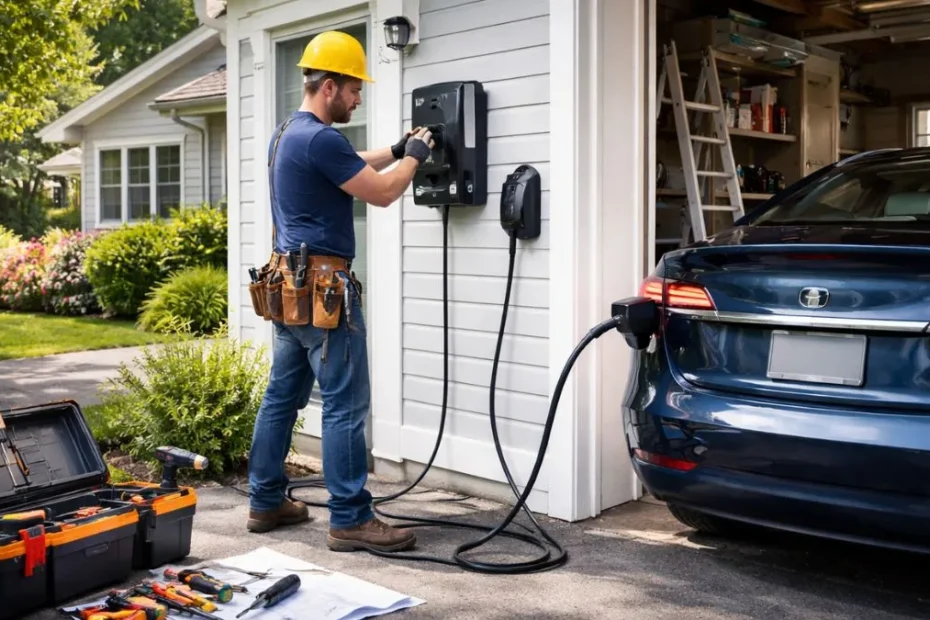
Electric vehicles (EVs) are increasingly becoming popular in the United States. The installation of a home EV charger is now a viable and affordable option when commuting to work. The number of drivers switching to electric has increased by the home EV charger.
Regardless of what type of EV you drive, Tesla, Ford, Chevrolet, or Hyundai, having your own home charging station is a convenient and cost-saving option as well as quicker than the rest.
This detailed manual informs about the procedure of installing a home EV charger in the USA, its prices, the permits, the requirements of electrical standards, safety considerations, and incentives.
EV Charger Levels
EV Chargers come in a variety of types and models.
Awareness of EV Charger Levels EV Chargers are available in many different types and models.
It is worth knowing the various levels of charging that can be used at home before it is installed.
Level 1 Charger
- Uses household outlet of 120 volts.
- Adds 3–5 miles of range per hour
- No installation is necessary other than a special outlet.
- Most suitable in the case of low daily mileage drivers.
Level 2 Charger
- Uses a 240-volt outlet
- Adds 20–60 miles of range per hour
- Professional installation must be done.
- Ideal for most homeowners
The majority of EV owners will select a Level 2 charger due to its higher reduction in the time spent charging and its increased convenience.
Step 1: Test Your Electricity capacity.
An analysis of the electrical panel capacity of the house is the initial step to installing a home EV charger.
Key Factors to Consider:
- Amp available in your electric panel.
- Panel rating (usually 100A, 150A, or 200A)
- Spacing of panel and garage/driveway.
- Existing load on your system
The majority of Level 2 chargers have 40 amp to 60amp circuit. A certified electrician will be able to calculate a load in order to decide whether your panel could cope with the extra load.
The panel may need an upgrade in case of insufficiency in capacity and this results in higher production costs.
Step 2: Select the appropriate EV Charger.
The residential EV chargers are numerous in the U.S. marketplace. When selecting one, consider:
- Speed of charge (kW)
- Smart capabilities (Wi-Fi connection, time scheduling, power monitoring)
- Cable length
- Indoor/outdoor rating
- Vehicle compatibility.
The most popular brands of home chargers are Tesla Wall Connector, Chargepoint, JuiceBox, etc. Ensure that charger is UL listed and is of U.S. electrical standard.
Step 3: The necessary permits should be obtained.
The installation of a Level 2 EV charger is permitted by an electrical permit in most cities and counties in the U.S.
Why Permits Matter:
- Ensures safety compliance
- Necessary to be insured.
- Eligibility requirement of rebates.
- Helps avoid fines
Allowances have different state and municipal requirements. The permit application and inspection is usually done by your electricians.
Step 4: Recruit a licensed Electrician.
Even though there are homeowners who opt to install it by themselves, it is highly advised to employ a licensed electrician.
With the assistance of a professional electrician, one will:
- Install a special 240 V circuit.
- Add a properly sized breaker
- Install wiring to code
- Install and assemble the charger.
- Check inspection when it is necessary.
Electrical maintenance should adhere to National electrical code (NEC). Poor installation will pose fire risks or cancel warranties.
Step 5: Process Overview of the installation.
The following is what normally occurs during installation:
- Inspector of electrical panel: electrician.
- Breaker dedicated is installed.
- The charging place is wired with 240 V.
- Charger is fixed on wall.
- Unit is connected and tested
- Last inspection is done (where necessary)
Installation takes 2- 5 hours, depending on the distance of wiring and the complexity of the panel.
How Much Does It Cost?
The cost of home EV charger installation is different in the United States.
Typical Cost Breakdown:
| Item | Cost |
|---|---|
| Charger unit | $400–$800 |
| Electrician labor | $500–$1,500 |
| Permit fees | $50–$300 |
| Panel upgrade (if needed) | $1,500–$4,000 |
| Average total cost | $1,000–$2,500 |
The electrical panel is cheaper when located in the garage and has space.
There are Federal and State Incentives.
States and the U.S. federal government provide incentives on the installation of EV chargers.
Federal Tax Credit
Homeowners can have a tax credit of 30 percent of the cost of installation (under a specific threshold) under the Inflation Reduction Act.
State & Utility Rebates
- Rebates of up to 200-1500 are given in many states and be utility companies.
- See your state energy agency or utility company about existing programs.
Garage as opposed to Outdoor Installation.
EV charger can be installed in:
- Garage (most common)
- Carport
- Driveway (including weatherproof unit)
Make sure that the charger is outdoor-rated (NEMA 3R or 4 rated) when it is exposed to the weather.
Safety Considerations
The most important thing should be safety.
- Use a dedicated circuit
- Install GFCI protection (where necessary).
- Remember not to put charging cable on the ground.
- Conduct regular inspections.
- Avoid extension cords
The EV chargers of the modern world are equipped with the safety mechanisms that have an automatic shutoff and temperature check.
The Smart Charging and Saving of Energy.
Smart EV chargers will enable you to:
- Booking at off-peak time.
- Monitor energy usage
- Integrate with solar panels
- Charging through the smartphone.
- TOUs can save a lot of money in terms of charging.
Should a Home EV Charger Be Installed?
The answer to the question is yes to the vast majority of EV owners.
Benefits:
- Overnight convenience of charge.
- Reduce long-term costs of charges.
- Increased home value
- Freedom of the state charging stations.
Home charging is the most viable and cost effective solution to day-to-day driving although the number of public charging networks is increasing.
The installation of an EV charger at home in the United States is a good investment choice of people who have electric vehicles. With the correct charger, a qualified electrician and the benefit of existing incentives, it is possible to develop a safe, efficient and future proof charging system at home.
With the further development of EVs in the country, owning a personal charging station is convenient, saves money, and gives a guarantee in the long term.