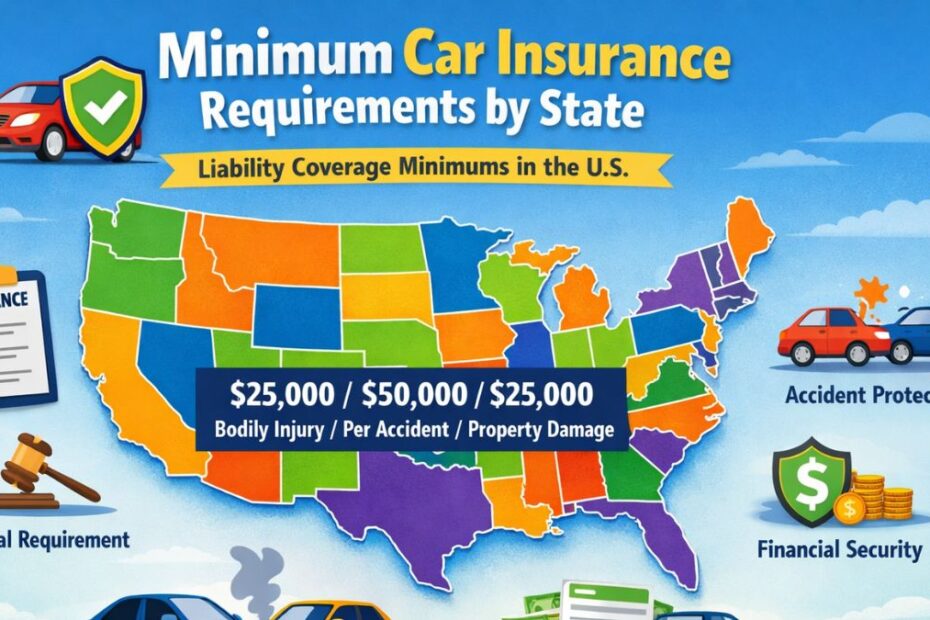
Purchasing an automobile insurance in the United States is not only a brilliant idea but virtually a mandatory law in nearly all the states in the country. However, there is one thing most drivers are unaware of, which is that the laws of car insurance vary in each state.
The amount of minimum coverage you should be having in Texas is not similar to California or Florida.
In this step-by-step guide, you will get to know about minimum car insurance requirements by state, what these numbers signify (such as 25/50/25), no-fault vs at-fault states and why minimum coverage is not necessarily sufficient.
What is the meaning of minimum car insurance?
Each of the states has a minimum limit of the liability insurance that a driver must have. This is the minimum legal requirement of driving in the roads.
Most states require:
- Bodily Injury Liability (BI) -Insurance against injury that you do to others.
- Property Damage Liability (PD) – This is the damage that you cause to the property of another person.
Knowing the Numbers (Example: 25/50/25)
If a state requires 25/50/25, it means:
- $25,000 per person for bodily injury
- Bodily injury 50,000 per accident.
- $25,000 for property damage
This is the most widespread format in U.S.
States Having 25/50/25 minimum coverage.
The conditions normally demanded in these states include:
- $25,000 bodily injury per person
- $50,000 bodily injury per accident
- $25,000 property damage
States include:
- Alabama
- Arizona
- Arkansas
- Colorado
- Georgia
- Illinois
- Indiana
- Louisiana
- Missouri
- Nevada
- Ohio
- Oklahoma
- Oregon
- South Carolina
- Tennessee
- Utah
- Wisconsin
This is regarded as a common minimum in most of the country.
States that have Higher Minimum Requirements.
Certain states demand greater security.
50/100/50 States
The conditions normally demanded in these states include:
- $50,000 per person
- $100,000 per accident
- $50,000 property damage
Examples:
- Alaska
- Maine
30/60/25 or Similar
States like:
- California (becoming more liberal)
- Texas
- Florida (different structure)
- North Carolina
Such states usually demand a little more per-person cap than 25/50/25.
States that are not Fault vs. States that are Fault.
There are also insurance regulations of no-fault and at-fault.
No-Fault States
In the no-fault states, it is your own insurance that handles your injuries regardless of who caused the accident. These states need Personal Injury Protection (PIP).
No-fault states include:
- Florida
- Michigan
- New York
- New Jersey
- Pennsylvania
- Kentucky
- Minnesota
- Massachusetts
- Hawaii
- Utah
The drivers in these states are required to have PIP cover that raises the minimum insurance premiums.
States With Alternatives to Insurance.
Some states permit other options to a bond or cash deposit.
New Hampshire
New Hampshire is the right state, where insurance is not necessary, but during the incident of your accident, you need to demonstrate that you have money.
Virginia
Previously, Virginia permitted drivers to pay an uninsured motorist fee rather than purchase insurance but the legislations are being revamped and majority of drivers have to obtain coverage.
Insurance is highly encouraged even in such states.
General Minimum Requirements of Liability by Category.
| Category | Typical Minimum Coverage | Example States |
|---|---|---|
| Low Standard | 25/50/25 | Texas, North Carolina |
| Higher Standard | 50/100/50 | Alaska, Maine |
| No-Fault States | Liability + PIP | Florida, Michigan, New York |
| Alternative Allowed | Special Rules | New Hampshire |
Note: It is always important to consult your state DMV about the requirements updated.
What will be your fate, should you drive without insurance?
Failure to ensure the necessary insurance in the course of driving may lead to:
- Heavy fines
- License suspension
- Suspension of vehicle registration.
- Court penalties
- Increasing insurance premiums in the future.
Certain states can also impound your car.
Is Minimum Coverage Enough?
Minimum insurance is not as much as legally required but it may not be sufficient to cover you.
Here is why:
- The cost of medical bills can be very high at over 25,000.
- Carmobiles can only be repaired or replaced at a cost of over 25000 dollars in the contemporary times.
- Criminal litigations may transcend policy boundaries.
At least, many experts suggest:
- 100/300/100 coverage
- The inclusion of uninsured/underinsured motorist coverage.
- Looking at an expense of collision and comprehensive.
The reason behind the difference of minimum requirements across states.
Insurance laws vary because:
- States vary in the density of traffic.
- Medical costs vary by region.
- The legal and litigation risks vary.
- Political and regulatory decision making is different.
By way of illustration, urban states may need increased limits because of increased risks of accidents and their costs.
Other forms of coverages you might require.
Consider: even though it may not be a requirement of your state, consider:
- Collision coverage- Covers car repairs.
- Complete coverage- Includes theft, fire, natural disasters.
- Uninsured Motorist coverage – Covers you against uninsured Motorists.
- Medical payments coverage – Assists in medical payments.
These are coverage with higher protection of finances than the minimum ones.
How to Find Out the Specifics of the Requirements of Your State?
To identify the minimum insurance requirements of your state:
- Go to the DMV of your state.
- Call your insurance company.
- Look over your state vehicle registration.
The laws related to insurance are subject to change hence it would be always important to see the limits before renewal or switching policies.
Conclusion
It is important that every driver in the U.S. comprehends the minimum car insurance requirements in the state. The legal minimum can make you be able to drive but in case of a serious accident, it might not be able to protect you completely. Medical expenses, lawsuits and car repairs can all easily surpass minimums.
The smartest approach is to:
- Be acquainted with the minimum state requirements.
- Look to external liability greater.
- Get optional coverage where you can afford it.
Insurance is not merely following the law, it is safeguarding your money and your future as well.